For most of human history, time was a local matter. Towns and cities set their clocks according to the sun's position directly overhead, a practice called solar or local mean time, and since noon arrives at slightly different moments depending on longitude, a traveler moving east or west would find clocks running minutes apart from one town to the next. This mattered little when travel was slow and communication slower still, but it became a genuine problem for commerce once railroads and telegraphs allowed goods, people, and information to move faster than local time differences could comfortably accommodate, a tension that pushed governments, railway companies, and scientific bodies across several countries toward standardized time over the final decades of the nineteenth century.
The push for standardization did not come from any single authority but emerged from overlapping pressures. Railway companies in Britain and North America were among the earliest and most insistent advocates, since a train schedule built on dozens of local times along a single route was a scheduling and safety hazard; two trains operating on slightly different clocks could end up on the same track at the same moment. Figures such as Sandford Fleming, a Scottish-Canadian railway engineer, and Charles Dowd in the United States were influential proponents of standardized time zones during the 1870s and 1880s, though historians generally describe them as prominent advocates within a much larger, multinational conversation involving astronomers, railway managers, and government officials rather than as sole originators of the idea.
Railway Time and the Push Toward Zones
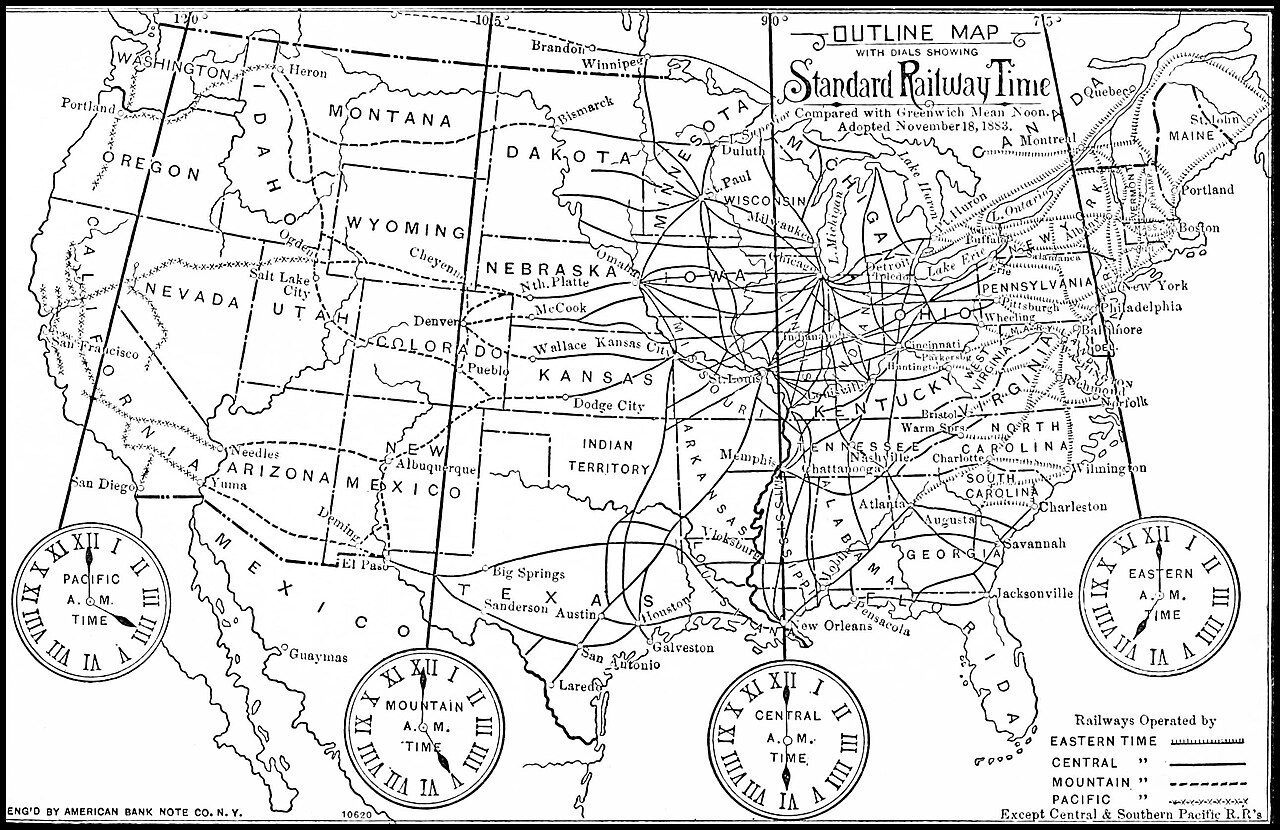
Britain adopted a national standard, Greenwich Mean Time, for railway purposes beginning in the 1840s, with the Great Western Railway among the early adopters, and this standard was formally extended to general civil use by 1880. The challenge was far greater in large countries spanning many degrees of longitude. The United States and Canada, where railroads by the 1870s operated on dozens of different local time standards set by individual cities and rail companies, moved toward a coordinated system when major American and Canadian railroads adopted a four-zone standard time system in November 1883, an agreement reached through industry coordination rather than federal legislation, since the United States Congress did not formally codify standard time zones into law until the Standard Time Act of 1918. This episode illustrates how commercial necessity frequently outpaced formal government action during this period, a dynamic also visible in the way telegraph networks expanded ahead of regulatory frameworks, discussed further in the telegraph and faster commercial communication.
International coordination followed national and corporate initiatives. The International Meridian Conference, held in Washington, D.C. in 1884, brought together representatives from numerous nations to establish Greenwich as the reference point, or prime meridian, for global longitude and timekeeping, from which standardized time zones could be calculated around the world. The conference did not immediately produce universal adoption; France, for instance, continued using Paris-based time for some official purposes for years afterward, and many countries only gradually aligned their civil time with the Greenwich-based system over subsequent decades. Many historians frame the conference as an important milestone in a longer, uneven process rather than a single moment when global time was settled.
Why Commerce Needed a Shared Clock
The commercial logic behind standardized time was straightforward once railroads and telegraphs connected distant places within hours rather than weeks. Shipping schedules, financial transactions, insurance contracts, and commodity trading all depended on participants in different locations agreeing on what time it actually was when an order was placed, a contract signed, or a cargo expected to arrive. Telegraphic price quotations from distant exchanges were only useful if recipients could reliably calculate how current the information was, which required a shared time reference across the network. Standardized time also supported the increasingly precise scheduling that large, bureaucratically managed enterprises, including railroads discussed in railroads and the expansion of inland trade, required to coordinate complex operations across wide territories.
Adoption was not without friction or cost. Communities whose local time diverged noticeably from their newly assigned zone time sometimes resisted the change, viewing it as an imposition by railway and commercial interests on the traditional rhythms of daily and agricultural life. Workers in factories and offices increasingly found their days governed by a standardized clock rather than by task completion or daylight, a shift that labor historians have linked to broader changes in industrial discipline and the intensification of work pace during this period. Some regions, particularly in colonized territories, had standardized time imposed on them as part of broader colonial administrative systems, with little local input into how zones were drawn or which meridian was chosen as the reference point, embedding the new timekeeping system within existing imperial power structures.
Geopolitical Dimensions of a Universal Clock
The choice of Greenwich as the prime meridian was not a neutral technical decision; it reflected Britain's dominant position in global shipping, cartography, and submarine cable networks at the time of the 1884 conference, and some delegations, notably France, pressed unsuccessfully for alternatives before eventually accepting the Greenwich standard for most practical purposes. Scholars studying this period note that the standardization of time, much like the standardization of cable networks and shipping routes, tended to reinforce the commercial and strategic advantages already held by leading maritime and industrial powers, even as it provided genuine practical benefits to the global trading system as a whole. For a wider view of how these communication-era shifts related to one another, see the communication era timeline.
Lasting Significance for Global Trade
By the early twentieth century, standardized time zones anchored to the Greenwich meridian had become the practical foundation for coordinating a globalizing economy, enabling synchronized financial markets, predictable transport schedules, and the kind of split-second price coordination that modern commodity and currency trading rely upon. The system established in the 1880s, later refined through international timekeeping bodies and eventually atomic clock standards in the twentieth century, remains in active use today essentially unchanged in its basic structure of twenty-four zones referenced to a shared meridian.
Later refinements built steadily on this foundation rather than replacing it. The introduction of Coordinated Universal Time in the mid-twentieth century, maintained through a global network of atomic clocks and periodically adjusted with leap seconds to stay aligned with the Earth's slightly irregular rotation, gave international commerce and navigation a timekeeping standard far more precise than the pendulum and transit-instrument methods available to the delegates who met in Washington in 1884. Financial markets, satellite navigation, and telecommunications networks today depend on this level of precision in ways that would have been unimaginable to nineteenth-century railway schedulers, even though the underlying zone structure they debated remains essentially intact.
Commentators at the time did not always perceive this standardization as uncomplicated progress. Some critics argued that imposing a uniform mechanical clock on human activity subordinated natural and local rhythms to the demands of commerce and industry, a critique that echoed broader anxieties about industrialization reshaping daily life. Whatever one makes of that argument, the practical outcome was that global trade gained a shared temporal framework it had previously lacked.
The standardization of time illustrates how even seemingly abstract infrastructure, something as intangible as agreement on what hour it is, became essential to the functioning of modern trade once technologies like the railroad, the telegraph, and the steamship collapsed the distances and timeframes over which commerce operated. Its history carries the same mixed legacy as those other innovations: a genuine gain in coordination and efficiency for global commerce, achieved partly by overriding local custom and embedding the advantages of already-dominant commercial powers into a system presented as universal and neutral.