Long before industrial smokestacks rose over Lancashire or New England, cotton was already one of the world's most widely traded textile fibers. Hand-spun and hand-woven cotton cloth moved along Indian Ocean trade routes for centuries, with South Asian weavers producing calicoes and muslins so fine that European buyers had no domestic equivalent. Many historians place the origins of cotton cultivation and spinning in the Indus Valley region several thousand years ago, long before cotton became entangled with the industrial economies of Europe and the Americas. What changed in the eighteenth and nineteenth centuries was not the fiber itself but the scale at which it was grown, processed, and traded — a transformation that turned cotton into the raw material underpinning the first wave of industrial globalization, and one that rested, to a disturbing degree, on forced labor.
From Ancient Fiber to Imperial Commodity
For much of the early modern period, finished Indian cotton textiles were the product European traders wanted, not raw fiber. The British East India Company and its rivals imported enormous quantities of Indian calico into Europe, where the cloth proved popular enough that domestic wool and linen weavers successfully lobbied for protective laws, including Britain's Calico Acts, restricting imported cotton cloth. Those restrictions, combined with growing demand, pushed British merchants and workshop owners to develop their own mechanized spinning and weaving capacity. Across the late 1700s, a cluster of overlapping innovations in spinning and weaving technology emerged from Lancashire's textile district — the product of many hands, workshops, and incremental improvements rather than any single inventor's breakthrough. As mechanized mills multiplied, they created a demand for raw cotton fiber far beyond what existing supply regions could provide.
The Cotton Kingdom and the Economics of Enslavement
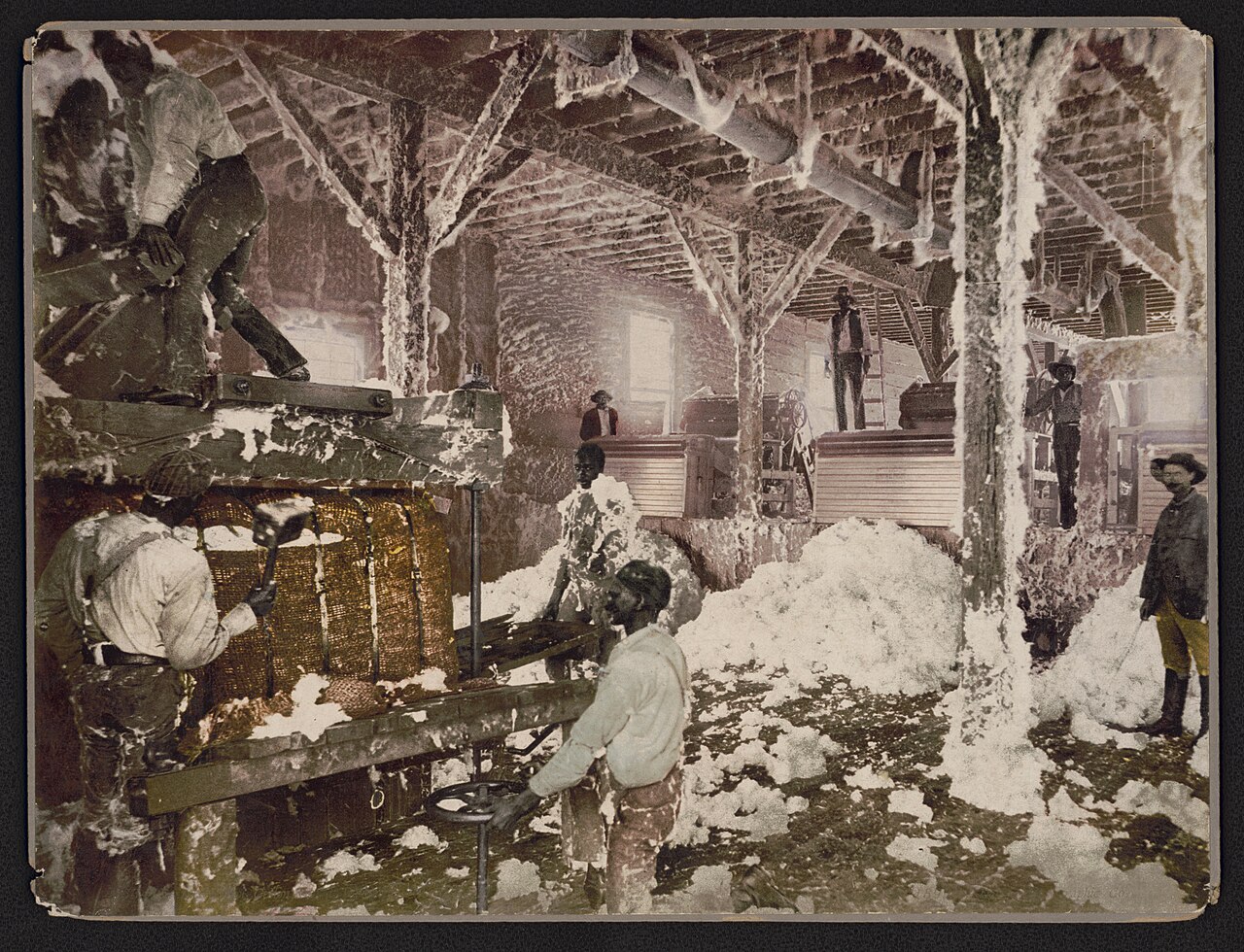
That demand was met, above all, by the expansion of cotton agriculture across the American South. A simple mechanical device for separating cotton fiber from its seeds, often associated in popular memory with a single late-eighteenth-century patent but built on similar tools already in informal use, sharply reduced the labor needed to process raw cotton and made upland varieties commercially viable at scale. The effect was not to reduce the demand for labor overall, but to intensify it: planters rapidly expanded cotton cultivation westward into Georgia, Alabama, Mississippi, Louisiana, and Texas, a region historians often call the "Cotton Kingdom." This expansion was built substantially on the forced labor of enslaved African Americans. By the 1850s, the enslaved population growing and processing cotton numbered well over a million people, and raw cotton exports accounted for roughly half of all United States export value. The profits flowed not only to planters but to merchants, bankers, insurers, and textile manufacturers in the American North and in Britain, whose industries depended on cheap, reliably supplied raw cotton. Domestic slave traders forcibly relocated enormous numbers of enslaved people from the Upper South to the expanding cotton frontier, a forced migration sometimes described by historians as a second displacement layered atop the Atlantic slave trade itself. Conditions on cotton plantations were notoriously brutal, with grueling picking quotas, violent discipline, and family separation used to extract maximum output.
After Emancipation: Sharecropping, Colonial Labor, and the Global Cotton Frontier
Emancipation during and after the Civil War ended legal slavery, but it did not end exploitative labor in the cotton fields. Many formerly enslaved people and their descendants became sharecroppers or tenant farmers, trapped in cycles of debt to landowners and merchants that left them with little real freedom of movement or negotiation. Convict leasing systems, which disproportionately targeted Black Southerners through discriminatory policing and courts, extended coercive labor practices well into the twentieth century in some states. Meanwhile, the disruption of American cotton exports during the Civil War, which produced severe hardship in Britain's textile districts, pushed British industry and government to cultivate alternative supply sources. Colonial administrators expanded export-oriented cotton cultivation in India and promoted large irrigation-fed cotton estates in Egypt, where British financial and political influence over Egyptian debt and governance shaped agricultural policy. These colonial cotton economies often relied on low-wage, debt-bound, or otherwise coerced labor, and they frequently displaced local food production in favor of export monoculture, leaving farming communities more vulnerable to price swings and famine.
Mechanization, Synthetic Competition, and the Modern Cotton Trade
The twentieth century brought further upheaval. Mechanical cotton pickers, which became widely adopted across the American South roughly in the decades after World War Two, sharply reduced the need for field labor and contributed to the Great Migration of Black Southerners toward northern and western cities in search of other work. At the same time, synthetic fibers such as rayon, nylon, and later polyester introduced new competition for cotton in textile markets. Cotton production itself globalized further, with China, India, the United States, Brazil, Pakistan, and West African nations including Mali, Burkina Faso, and Benin all becoming significant producers. Government subsidies to cotton growers in wealthy countries, particularly the United States, have been repeatedly criticized by developing-country producers and by trade bodies for depressing world cotton prices and undercutting smallholder farmers who have no comparable government support, a dispute that has featured prominently in negotiations discussed in the history of global trade rule-making. Forced labor concerns did not disappear either: human rights organizations documented state-organized forced labor in Uzbekistan's cotton harvests well into the 2010s, prompting international boycott and certification campaigns that contributed to policy reforms. Cotton cultivation has also carried heavy environmental costs, including intensive water use and pesticide application; the shrinking of the Aral Sea, driven substantially by Soviet-era cotton irrigation, stands among the starkest examples of agricultural trade reshaping an entire ecosystem.
Cotton's Legacy in Today's Commodity Markets
Cotton remains a heavily traded global commodity, bought and sold on futures exchanges and woven through supply chains that stretch from West African and South Asian farms to garment factories in East and Southeast Asia and retail shelves across the wealthy world. Certification and traceability programs, including the Better Cotton Initiative and various fair trade schemes, have emerged in response to persistent concerns about labor conditions and environmental sustainability in cotton-growing regions, and allegations of forced labor tied to cotton production in China's Xinjiang region have drawn renewed international scrutiny in recent years. The deeper lesson of cotton's trade history is one of duality: the fiber helped power the industrial transformation of the Atlantic world and generated extraordinary wealth, yet that wealth was extracted substantially through enslaved and coerced labor systems whose consequences shaped economies, migration patterns, and racial inequality for generations. That history continues to inform present-day debates over supply-chain transparency, labor standards, and who truly bears the cost of cheap raw materials in global trade.