Along the southern edge of the Sahara, the medieval Empire of Mali grew, over roughly two centuries beginning in the early 1200s, into one of the wealthiest and most influential states in Africa, built on its control of trade routes carrying gold northward and salt southward across one of the harshest environments on earth. Mali's rulers did not invent this trade; they inherited and expanded a commercial system that had already enriched the earlier Ghana Empire for centuries before Mali's rise. Understanding Mali requires looking past any single ruler's biography and toward the deeper economic logic of gold and salt that made the empire possible in the first place.
Gold Fields, Salt Mines, and the Logic of Long-Distance Exchange
West Africa held some of the richest gold deposits known to the medieval world, concentrated in goldfields south of the Mali heartland near the upper Senegal and Niger River systems. Gold alone, however, was of limited use to the people who mined it without a counter-trade in goods they needed, chief among them salt, essential for diet and food preservation and scarce across much of the West African interior. Saharan salt, extracted at sites such as Taghaza, traveled south by camel caravan in exchange for gold moving north, with Mali's rulers positioned to tax and protect this exchange as it passed through cities under their control, including Timbuktu, Gao, and Walata. Historians sometimes describe this arrangement as a "silent trade," based on accounts—of uncertain reliability—describing gold and salt left for exchange without direct contact between parties, though most scholars now treat such stories cautiously rather than as a literal description of how the trade generally worked. What is better documented is that control over the taxation and security of these exchanges, rather than control over the mines themselves, was the real source of Mali's state revenue, since the empire's rulers rarely controlled the goldfields directly and instead profited from the routes and markets through which gold passed.
Beyond gold and salt, Mali's trade networks also carried kola nuts, textiles, copper, and enslaved captives southward and eastward into forest-zone markets, while cloth, horses, and manufactured goods from North Africa moved in the opposite direction. This range of commodities meant that Mali's economy, while often remembered chiefly for gold, actually rested on a diversified set of exchanges connecting the Sahel to both the Sahara and the forest regions further south.
Crossing the Sahara was a dangerous and costly undertaking regardless of how valuable the cargo being carried. Camel caravans could number in the hundreds or even low thousands of animals, guided by Berber and Tuareg guides whose knowledge of wells, seasonal routes, and the Sahara's shifting dunes was essential to survival; losing the way or misjudging water supplies could be fatal for an entire caravan. Cowrie shells, imported from the Indian Ocean, circulated as a form of currency in many Mali markets alongside gold dust, which was sometimes weighed using standardized measures to help prevent disputes, another sign of how institutionalized the gold trade had become by the fourteenth century.
Mansa Musa's Pilgrimage and the Limits of "Great Man" History
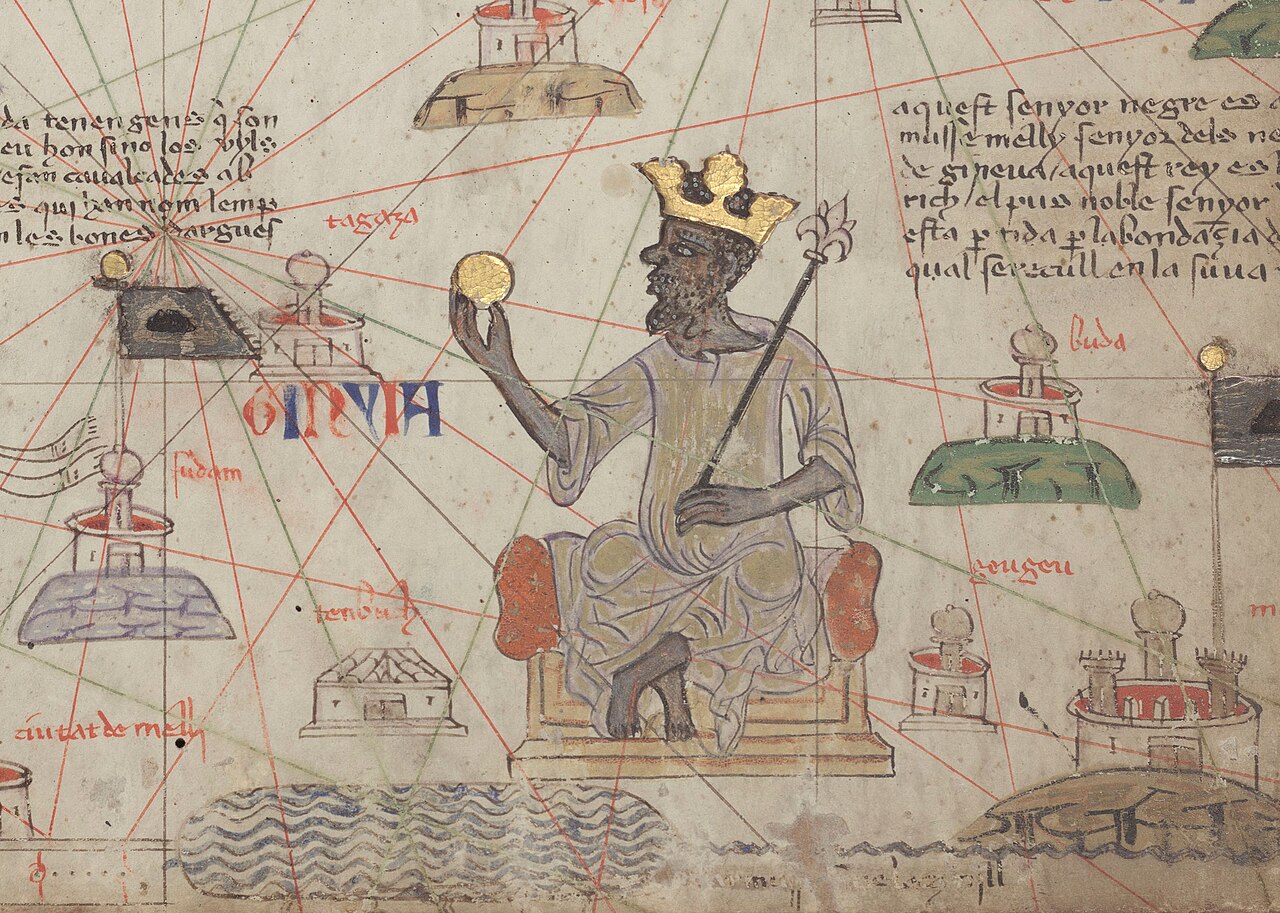
Mali's best-known ruler in the historical record outside Africa is Mansa Musa, who reigned in the first half of the fourteenth century and undertook a famous pilgrimage to Mecca around 1324, reportedly traveling with an enormous retinue and distributing so much gold along the way—particularly in Cairo—that some accounts describe a temporary disruption to local gold prices. This journey is often presented in popular accounts as the moment Mali's wealth became visible to the wider world, and Mansa Musa is sometimes framed as a singularly transformative figure. It is more accurate to understand his pilgrimage as a dramatic display of wealth that already existed, generated by a trade system built over generations by many Mali rulers, merchant families, and the broader Mande-speaking trading networks that operated across the empire—his personal journey revealed Mali's wealth to distant observers rather than creating that wealth himself. Later European maps, including the well-known Catalan Atlas of 1375, depicted a crowned African ruler holding a gold nugget, a sign of how far Mali's reputation for wealth had spread, filtered through the reports of North African traders and scholars.
Maintaining control over such a vast and ethnically diverse territory required a substantial administrative and military apparatus. Mali's rulers appointed provincial governors over conquered regions, maintained a standing military force that could be mobilized to protect trade routes or suppress revolts, and relied on a class of free merchants, sometimes identified with the Wangara or Dyula trading networks, who operated commercial networks that extended well beyond Mali's formal political boundaries. This administrative structure, built up over generations, is what allowed the wealth generated by gold and salt to be converted into lasting political power rather than remaining a matter of individual merchant fortunes.
Timbuktu, Islamic Scholarship, and the Social Costs of Empire
Mali's wealth supported a significant expansion of Islamic scholarship, particularly in Timbuktu, where mosques, libraries, and schools attracted scholars and students from across West Africa and the wider Muslim world; manuscripts produced and collected there, some of which survive today, cover subjects ranging from law and theology to astronomy and medicine. This cultural flourishing, however, existed alongside the less celebrated foundations of imperial power: Mali's expansion relied on military conquest of neighboring peoples, the extraction of tribute from subordinate regions, and participation in trans-Saharan trade networks that included the sale of enslaved people northward across the desert alongside gold, ivory, and other goods. The empire's wealth was real, but it was not distributed evenly, and the human costs of conquest and the slave trade are as much a part of Mali's history as its scholarship and architecture.
Decline and Mali's Lasting Place in Global Trade History
Mali's power gradually weakened over the fifteenth century due to succession disputes, the secession of subordinate territories, and the rise of the rival Songhai Empire, which eventually absorbed much of Mali's former territory and trade network, including Timbuktu itself by the late 1400s. Mali's decline did not end trans-Saharan trade, which continued under Songhai and later powers, but it did mark the end of Mali's particular dominance over the gold-salt exchange. The empire's legacy persists in the architecture of Timbuktu (recognized today as a UNESCO World Heritage site), in the manuscripts preserved there, and in the enduring historical memory of Mali as evidence that sub-Saharan Africa participated actively and powerfully in medieval global trade rather than standing apart from it. For a comparison with how a very different African trading system operated along the Indian Ocean coast during roughly the same centuries, see our article on the Swahili Coast and the Indian Ocean city-states, and for more on the broader medieval trading world, visit our medieval trade timeline.