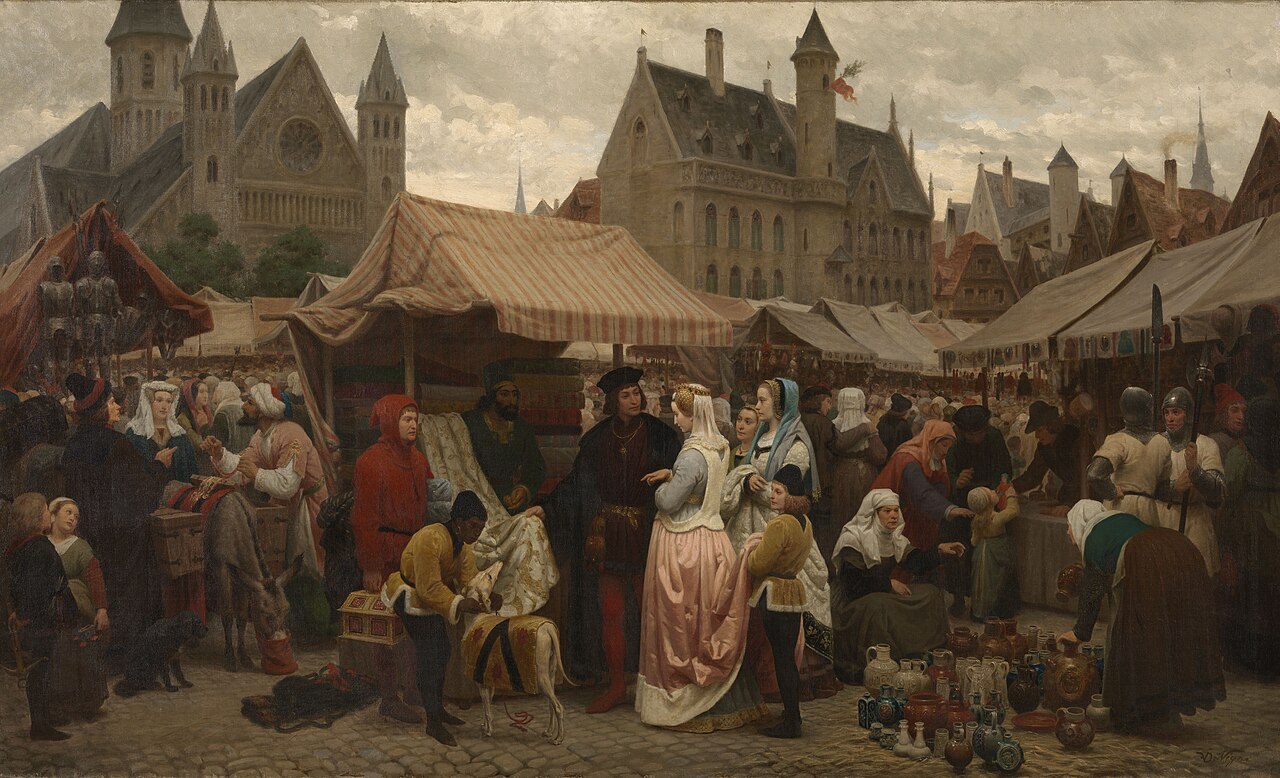
Long before national governments issued currency standards or multinational banks existed, medieval Europe built much of its commercial infrastructure around a surprisingly simple institution: the seasonal fair. Held in towns across France, the Low Countries, England, and the Holy Roman Empire, these gatherings brought together merchants, artisans, moneylenders, and buyers from dozens of regions for days or weeks at a stretch. Many historians trace the growth of these fairs to the eleventh and twelfth centuries, when a combination of relative political stability, population growth, and agricultural surplus allowed local economies to produce more than they needed for subsistence. That surplus needed an outlet, and fairs provided one.
From Local Markets to Regional Fairs
Weekly local markets had existed in Europe since antiquity, serving the basic exchange needs of a town and its surrounding countryside. Fairs were different in scale and ambition. Typically tied to a religious feast day or the patronage of a local lord, bishop, or monastery, a fair might draw merchants from several hundred miles away, offering goods that a weekly market never could. Sources place the earliest large-scale fairs in the Frankish territories as early as the Carolingian period, though the institution did not reach its full commercial importance until the central Middle Ages, roughly the eleventh through thirteenth centuries, when trade routes connecting northern Europe to the Mediterranean became more reliable.
Lords and towns had strong incentives to host fairs. Tolls, rents on stalls, and fees for using official weights and measures generated substantial revenue, and a thriving fair enhanced a town's prestige and attracted permanent settlement. In return, organizers typically guaranteed merchants safe passage and protection from arbitrary seizure of goods, a critical concession in a political landscape fragmented among competing lordships.
The Champagne Fairs and the Rhythm of Commerce
The most celebrated example, and the one most often cited by economic historians, is the cycle of fairs held in the County of Champagne, in what is now northeastern France. Beginning in the twelfth century, the counts of Champagne organized a rotating sequence of six fairs held in towns including Lagny, Bar-sur-Aube, Provins, and Troyes, arranged so that one fair was effectively always underway somewhere in the county. For roughly two centuries, the Champagne fairs functioned as a hinge between the cloth-producing towns of Flanders and northern France and the long-distance trade networks of Italian merchants, who brought silk, spices, alum, and other goods originally sourced from the eastern Mediterranean and beyond.
What made Champagne especially significant was not only the volume of goods exchanged but the financial innovations that developed around it. Merchants needed ways to settle debts across the fair cycle without hauling heavy coin across hundreds of miles of unreliable roads. Letters of credit, bills of exchange, and standardized contracts emerged and matured in this environment, administered in part through fair courts that applied a body of commercial custom historians often call the "law merchant." These courts resolved disputes between merchants from different jurisdictions relatively quickly, which was essential to maintaining trust among parties who might never meet again after a given fair season ended.
Goods, Guilds, and the People Who Made Fairs Work
The goods traded at major fairs reflected the breadth of medieval European commerce. Flemish and English wool and finished cloth were centerpieces, alongside leather, furs, wine, grain, salt, and metal goods such as tools and weapons. Italian merchants, operating through emerging banking houses based in cities such as Florence, Siena, and Genoa, supplied spices, silk, and dyestuffs carried along Mediterranean routes connected to the maritime trade networks linking Europe to the Middle East and beyond, including the networks described in the history of the spice trade.
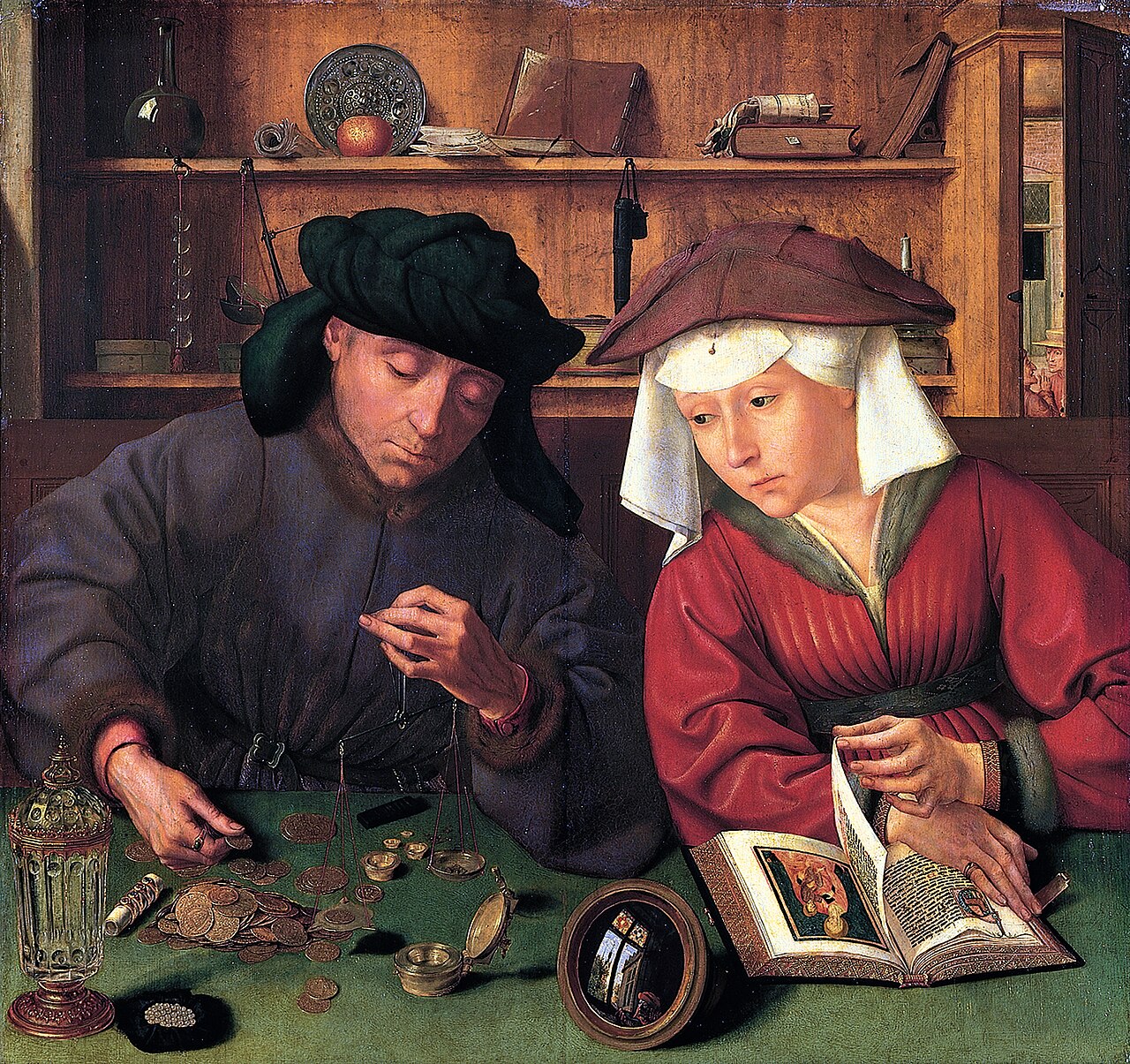
Merchant guilds and emerging trading associations, including the early Hanseatic League in northern Germany, organized collective bargaining power and shared security arrangements for members traveling to distant fairs. Moneychangers and early bankers set up tables, literally "banco" in Italian, to exchange the dozens of competing regional currencies in circulation, a practical necessity in a Europe without a unified coinage system. Fairs also employed and depended on a large support economy: innkeepers, cart drivers, scribes who drafted contracts, notaries, and armed escorts who protected goods moving along the roads.
Benefits, Burdens, and the Limits of the Fair Economy
The expansion of regional fairs brought genuine economic benefits. They accelerated the circulation of goods and capital, encouraged specialization in regional production such as Flemish cloth or English wool, and gave rise to commercial and legal practices that underpin modern contract law and banking. Towns that hosted successful fairs often grew into significant urban centers, and the merchant class that profited from fair trade became an increasingly influential political force, eventually challenging the dominance of landed nobility in some regions.
These benefits were unevenly distributed. Tolls and fees fell heavily on smaller traders and peasants who had little bargaining power, while large merchant houses and the lords who licensed fairs captured most of the profit. Rural producers who sold wool or grain at fixed, pre-arranged prices often bore the risk of poor harvests without sharing proportionally in boom years. The same roads and crowded fairgrounds that moved goods also moved disease; historians generally agree that the dense, itinerant mixing of people at fairs and markets contributed to the rapid spread of the Black Death across Europe beginning in 1347, though the plague's ultimate origins lay in much longer trade routes stretching toward Central Asia. Fairs were also exclusionary institutions in various ways: Jewish moneylenders and merchants, who played an important role in medieval credit markets, frequently faced discriminatory tolls, forced relocations, and periodic violent persecution, even as their financial services were widely used.
By the fourteenth century, the great fairs of Champagne and similar circuits elsewhere in Europe began to decline, a shift many economic historians attribute to a combination of factors: the Hundred Years' War disrupting northern French trade routes, the rise of permanent urban markets and resident merchant colonies that reduced the need for seasonal gatherings, and the growing importance of maritime shipping routes through the Mediterranean and later the Atlantic, which allowed merchants to bypass overland fair circuits altogether.
Closing Thoughts on Lasting Significance
Medieval fairs did not simply fade into irrelevance; their institutional innovations persisted long after the fairs themselves lost prominence. The commercial law developed in fair courts fed into the legal traditions that later governed international trade. The credit instruments pioneered by Italian and Flemish merchants became the basis for early modern banking. Even the seasonal, cyclical structure of major fairs influenced how later trading institutions, including some operating along the sea routes examined in accounts of Southeast Asian maritime trade, organized their own calendars around predictable monsoon and shipping seasons. In this sense, the medieval fair stands as an important bridge between the localized, custom-based exchange of the early Middle Ages and the increasingly standardized, long-distance commercial systems that would come to define trade in the centuries that followed.