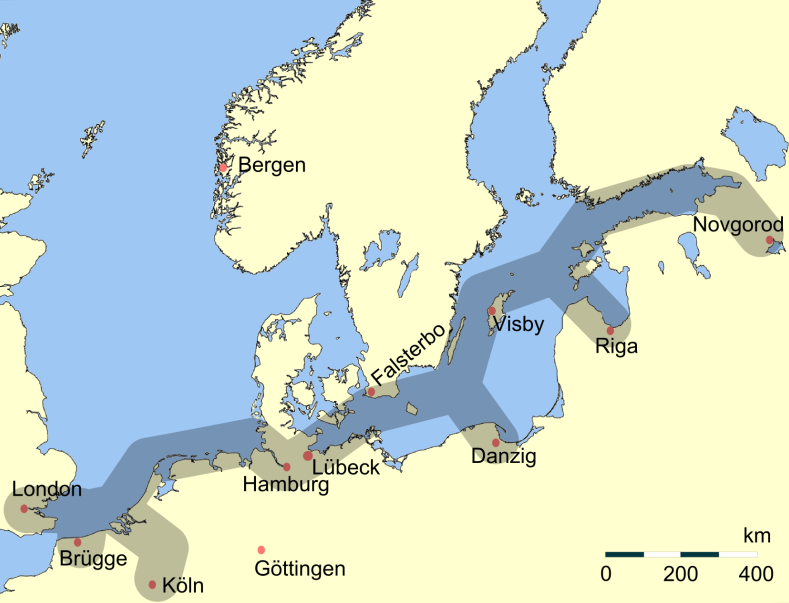
Across the Baltic and North Seas during the medieval and early modern periods, a distinctive form of commercial organization emerged that was neither a kingdom nor a single company but a flexible alliance of merchant communities and towns known as the Hanseatic League, often simply called the Hansa. Many historians trace its origins to informal cooperation among German merchant guilds beginning sometime in the twelfth century, with the city of Lübeck, founded in 1143 and rebuilt after a fire in 1159, often identified as an early anchor of the network. The League gradually formalized over the following century, and most historians place its most active and influential period between roughly the thirteenth and fifteenth centuries, when it linked dozens of towns stretching from London and Bruges in the west to Novgorod in the east.
A Merchant-Led Alliance Without a Central Government
What made the Hanseatic League unusual among major premodern trading systems was its organizational structure. It was not ruled by a king, emperor, or single governing body in the way many other trading networks were, but instead functioned as a federation of autonomous or semi-autonomous towns and the merchant guilds within them, who cooperated for shared commercial advantage while generally retaining significant independence in local governance. Member towns and merchant communities periodically sent representatives to meetings, often held in Lübeck, to coordinate policy, resolve disputes, and negotiate collectively with the various kings, princes, and other rulers whose territories contained Hanseatic trading posts, called kontors. This structure allowed the League to project considerable collective economic and sometimes military leverage, including the ability to impose trade embargoes on rulers or cities that threatened Hanseatic interests, without requiring the kind of centralized bureaucracy that empires elsewhere depended on.
At its height, the League is generally described as including somewhere between roughly seventy and two hundred towns with varying degrees of formal participation, a range reflecting both the loose nature of membership and the fact that historians continue to debate exactly how to count affiliated versus core member cities. Major kontors, essentially fortified merchant compounds with trading privileges granted by local rulers, operated in cities including London, Bruges, Bergen, and Novgorod, giving League merchants secure footholds and legal protections in foreign territories well beyond the German-speaking lands where the League originated.
Goods, Routes, and the Economic Glue of Northern Europe
Hanseatic trade centered heavily on bulk goods suited to northern European economies and climates. Baltic grain, timber, furs, wax, and amber moved westward, while salt, cloth, wine, and manufactured goods moved in the other direction. Fish, particularly herring, caught and heavily salted or dried for preservation, became one of the League's most important commodities, supporting both regional diets and a substantial export trade, including to Catholic Europe where dietary rules around fasting created steady demand for preserved fish. Copper and iron from Sweden also moved through Hanseatic trading networks, feeding demand for metal goods across the region.
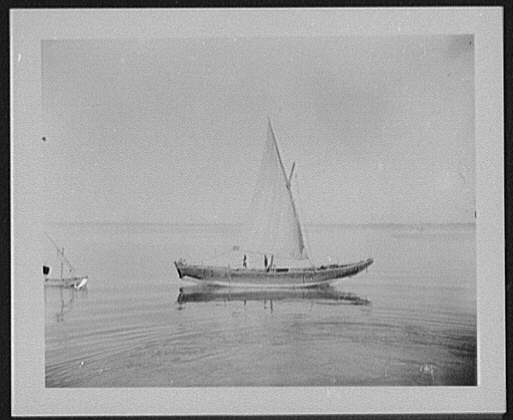
The League's merchants developed shared commercial and legal practices, including standardized weights, measures, and forms of commercial law, that reduced the friction and uncertainty of trading across many different political jurisdictions, an institutional innovation not unlike the standardized law that had earlier supported trade across the Roman world, discussed in this site's article on Roman roads and commercial expansion. The characteristic Hanseatic cargo ship, known as the cog, featured a flat bottom and substantial cargo capacity suited to the often shallow harbors and rough conditions of the North and Baltic Seas, and its design became widely used by merchants both inside and outside the League. This combination of shared legal infrastructure and suitable maritime technology allowed the League to move bulk goods efficiently across a region that had previously lacked this level of commercial coordination.
Power, Rivalry, and the League's Eventual Decline
The League's economic influence came with real friction and genuine costs for others. Hanseatic merchants often secured exclusive or highly favorable trading privileges from local rulers, sometimes at the expense of local merchants in host cities, who resented the competitive advantages granted to foreign traders and periodically pushed back through local political action or violence against Hanseatic kontors. The League was also willing to use coercive economic pressure, including embargoes and, on occasion, armed conflict, against rulers or rival trading powers, most notably in a series of conflicts with Denmark during the fourteenth century, to protect or expand its commercial privileges, showing that the League's commercial success rested in part on its capacity for organized economic and military coercion rather than purely voluntary exchange.
By the sixteenth century, several converging pressures began eroding the League's dominance. The rise of increasingly centralized and assertive territorial states, including Denmark, Sweden, and England, which sought to limit foreign merchant privileges in favor of their own domestic traders, reduced the special legal protections Hanseatic merchants had long relied upon. Competition from Dutch and English merchants, who developed their own efficient shipping and trading networks, gradually displaced Hanseatic merchants from trades they had previously dominated. Shifts in European trade patterns following the opening of Atlantic and broader global trade routes in the fifteenth and sixteenth centuries also reduced the relative importance of the older Baltic-North Sea trading axis the League had been built around. Formal Hanseatic assemblies continued meeting into the seventeenth century, with some historians marking 1669 as the date of the last full assembly, by which point the League's practical economic influence had diminished considerably from its medieval peak.
Lasting Significance for European and Global Trade
The Hanseatic League's history offers a distinctive counterpoint to trade networks built around empires or single dominant states, showing how merchant-led cooperation among nominally independent towns could sustain a large, durable, and economically significant trading system for several centuries without centralized political rule. Its emphasis on standardized commercial law, shared infrastructure investment, and collective bargaining power foreshadowed organizational features later visible in modern trade associations and some aspects of international commercial law. The cities that once anchored the League, including Lübeck, Hamburg, and Bremen, retain visible architectural and institutional legacies of this period, some recognized today through UNESCO World Heritage designations, and northern Europe's long-standing trading ties among Baltic and North Sea states trace meaningful roots to the commercial infrastructure the League helped build. At the same time, the League's reliance on exclusive privileges and occasional coercive tactics against rivals and host communities is a useful reminder that even cooperative, merchant-driven trade systems could produce real winners and losers, a pattern visible across many of the trading networks explored throughout this site's medieval trade timeline.