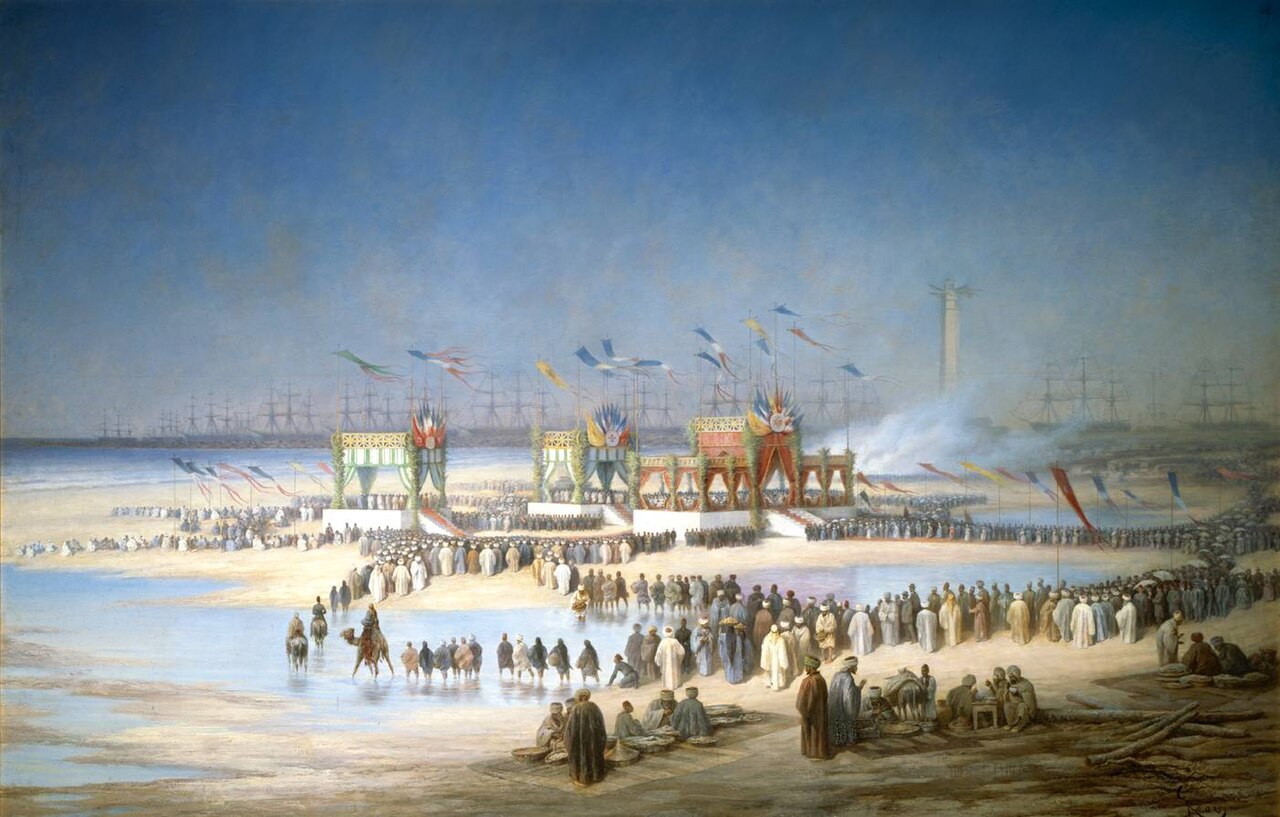
For centuries, a ship sailing from a European port to India or China had to round the entire continent of Africa, a journey of months and thousands of extra miles. The opening of the Suez Canal in 1869 changed that calculation almost overnight, carving a navigable waterway across the Isthmus of Suez that connected the Mediterranean Sea directly to the Red Sea and, from there, to the Indian Ocean. The canal's construction and subsequent history illustrate both the transformative power of engineering on global trade and the deep human and geopolitical costs that often accompanied projects built under colonial-era conditions.
Ancient Dreams of a Waterway Between Seas
The idea of linking the Mediterranean and Red Seas was not new in the nineteenth century. Ancient Egyptian rulers are believed to have built and maintained earlier canals connecting the Nile River to the Red Sea at various points over the centuries, and sources suggest these waterways were used intermittently for trade and military transport before eventually silting up and falling out of use. French general and later emperor Napoleon Bonaparte, during his 1798 campaign in Egypt, ordered surveys to assess the feasibility of a canal directly across the isthmus, though his engineers reportedly concluded, based on since-disputed measurements, that sea levels between the two bodies of water differed too much to make the project workable.
Renewed interest emerged in the mid-nineteenth century, driven by European commercial ambitions in Asia and advances in engineering and surveying that resolved the earlier doubts about sea-level differences. A French diplomat, Ferdinand de Lesseps, became a key organizer and promoter of the project, but the canal's construction depended on the cooperation of the Egyptian ruler, or khedive, Sa'id Pasha, who granted the concession, as well as on French engineers, financiers, and thousands of Egyptian laborers, and should not be understood as the achievement of any single individual.
Building the Canal: Engineering, Finance, and Forced Labor
Construction began in 1859 under the Suez Canal Company, a French-chartered enterprise that raised capital largely from French investors, with the Egyptian government also holding a substantial ownership stake. The physical work of digging the roughly 100-mile channel fell heavily on Egyptian laborers, and for much of the project's early years that labor was organized through a system of corvée, or forced conscripted labor, imposed on Egyptian peasants by their own government under pressure from the canal company. Scholars estimate that tens of thousands of laborers were compelled to work on the canal under harsh conditions, and historical accounts describe significant suffering and loss of life, though precise mortality figures from this period are difficult to establish with certainty. International criticism of the corvée system eventually contributed to its abandonment in favor of paid labor and imported steam-powered excavation equipment in the canal's later construction years.
The project also left Egypt deeply indebted. The Egyptian government's heavy borrowing to finance its share of the canal, combined with other debts, contributed to a financial crisis that, within just a few years of the canal's 1869 opening, forced the Egyptian ruler to sell his government's canal shares to the British government in 1875, a transaction that gave Britain a controlling financial interest in a waterway it did not build.
A New Route to the East: Impact on Global Shipping
The canal's effect on shipping distances and times was dramatic. A voyage from London to Bombay that had previously required sailing around the Cape of Good Hope could, via the Suez Canal, be shortened by roughly a third or more in distance, depending on the specific ports involved. The canal particularly favored steamships over traditional sailing vessels, since steamers could pass through the narrow, often windless canal reliably, while sailing ships often struggled with the Red Sea's unpredictable winds, giving steam-powered shipping an additional competitive advantage that accelerated its displacement of sail across global trade routes in the decades after the canal opened. British trade with India and East Asia benefited enormously from the shortened route, reinforcing the strategic and commercial value Britain placed on the waterway.
Control, Conflict, and the Geopolitics of a Narrow Passage
Because the canal offered such an enormous strategic shortcut, control over it quickly became a matter of international power politics rather than commerce alone. Britain's 1875 purchase of Egyptian canal shares was followed in 1882 by a British military occupation of Egypt, justified partly by British interests in securing the canal route to India, and Egypt remained under heavy British influence for decades afterward. The canal's strategic importance was underscored again in 1956, when Egyptian President Gamal Abdel Nasser's nationalization of the Suez Canal Company triggered a brief but serious international crisis involving British, French, and Israeli military action, generally known as the Suez Crisis, which ultimately confirmed Egyptian sovereign control over the waterway.
The Suez Canal's Continuing Role in World Trade
Today the Suez Canal remains one of the most important chokepoints in global trade, handling a very large share of world container shipping and a significant portion of global oil shipments, according to figures regularly published by the Suez Canal Authority and tracked by international shipping organizations. Its continued importance, and vulnerability, was vividly illustrated in 2021, when the container ship Ever Given became lodged across the canal for nearly a week, blocking traffic in both directions and disrupting global supply chains, a reminder of how much of the modern trading world still depends on a single narrow passage first opened in 1869. From its origins as a colonial-era engineering project built partly on forced labor to its current role moving a substantial share of the world's seaborne trade, the Suez Canal illustrates how infrastructure, politics, and global commerce remain deeply intertwined. Readers can see how this fits into the broader story of industrial-era trade on the industrial era timeline.